Tiếng Việt
Orientation for the development of physics to enhance the national scientific and technological capacity
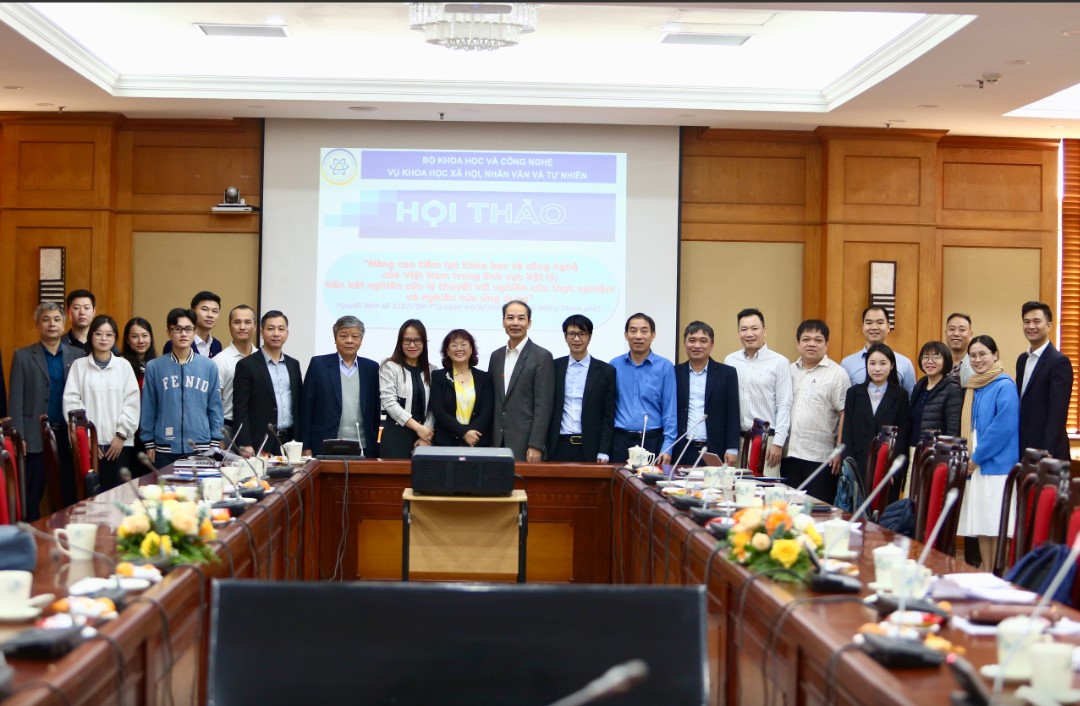
On December 18, 2025, in Hanoi, the Ministry of Science and Technology organized a workshop to review the five-year implementation of the Physics Development Program for the period 2021–2025 (Program 1187). The workshop aimed to evaluate the outcomes of physics research development nationwide and to propose key orientations and solutions for the subsequent phase.
Attending the workshop, there were representatives of the Ministry of Science and Technology, the Ministry of Education and Training, the Vietnam Academy of Science and Technology, national universities, the National Foundation for Science and Technology Development (NAFOSTED), as well as numerous leading scientists, experts, and representatives of agencies responsible for and leading science and technology projects under Program 1187.
Assoc. Prof. Vo Thanh Tung, Rector of the University of Sciences, Hue University, as a coordinator of a national-level science and technology project under Program 1187, participated in the workshop and contributed valuable ideas. In her opening remarks, Ms. Le Yen Dung, Deputy Director of the Department of Natural Sciences, Humanities and Social Sciences, emphasized that physics serves as a fundamental discipline underpinning many modern scientific and technological fields, including quantum technologies, advanced materials, high-energy physics, semiconductor technology, supercomputing, and artificial intelligence. She further highlighted that the implementation of Program 1187 reflects the Government’s strategic commitment to strengthening national scientific and technological capacity while fostering closer linkages between theoretical research, experimental research, and applied research.
After five years of implementation, Program 1187 has achieved significant results. Vietnam’s physics research capacity has been substantially enhanced, with the proportion of academic staff holding doctoral degrees at key training and research institutions reaching 80–90%, exceeding the established targets. Considerable investment has been made in key laboratories and modern research facilities, particularly at the Vietnam Academy of Science and Technology, Vietnam National University, Hanoi, and Vietnam National University, Ho Chi Minh City.
A notable highlight is the marked improvement in the international publication capacity of the Vietnamese physics community. The Journal of Science: Advanced Materials and Devices (JSAMD) achieved an impact factor of 8.0, ranking in the Q1 category in four subject areas. In addition, several strong research groups have been established, attracting the active participation of scientists and researchers from both domestic and international institutions.
Within the framework of Program 1187, numerous national-level science and technology projects have been effectively implemented. Among them is the project entitled “Research and Fabrication of Piezoelectric Transducers for Applications in Hydroacoustic and Ultrasonic Devices” (Project Code DTDL.CN 34/24), led by Assoc. Prof. Vo Thanh Tung. The project was highly commended for its scientific significance, technological mastery, and promising applications in ultrasound and hydroacoustics, contributing to both socio-economic development and national defense and security.

The workshop also acknowledged positive outcomes in international cooperation. Vietnam has continued its active membership in the Joint Institute for Nuclear Research (JINR – Dubna), while strengthening collaborative activities with major international research centers, such as KEK, CERN, and RIKEN, through co-funding and joint research models.
Alongside these achievements, participants candidly identified several challenges, including limited research funding, difficulties in accessing large-scale research infrastructure, uneven capacities among research groups, and a declining trend in SCOPUS-indexed publications in the field of physics. These issues underscore the need for more robust and targeted solutions in the coming period.
In his contribution to the discussion, Assoc. Prof. Vo Thanh Tung emphasized the pivotal role of universities in advancing physics through the training of high-quality human resources, the development of strong research groups, and the strengthening of linkages between fundamental research, applied research, and innovation.